
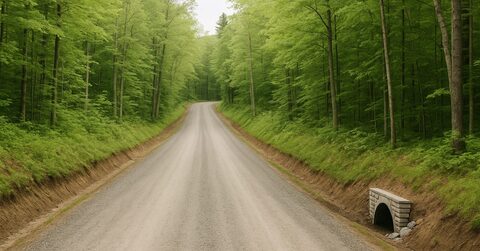
If you have a dirt driveway or private road in Windham County, Vermont, you probably already know that mud season is its own kind of stress test. Ruts deepen, water pools where it never used to, and gravel seems to disappear year after year no matter how much you put down. These are not random problems, and throwing more stone at them rarely fixes anything for long.
The questions below come from real conversations with homeowners and road associations across Windham County. Some people call after a washout. Others have been watching a soft spot get worse for two or three seasons and want to understand what is actually happening before they spend money. A few just want to know what a grading visit looks like and what it costs.
The short version of what we do: every job starts with a drainage diagnosis. That means walking the road or driveway and tracing where water is coming from, where it is going, and where it is sitting when it should not be. A crowned surface that sheds water, a clear ditch that moves it away, and a culvert sized for the volume it needs to carry will do more for a road than a full load of gravel spread on top of the same old problems.
Vermont dirt roads move. Frost heave lifts and drops the surface every winter, and the crown that was graded in years ago gradually flattens out. Once the crown is gone, rain runs down the tire tracks instead of off to the sides, and the road starts to wash from the inside. The fix is restoring the crown and making sure the ditches can actually carry the runoff away. If a culvert is undersized, crushed, or silted up, even a well-graded road will develop wet spots and soft sections.
Road associations have the added complexity of shared decision-making and budgets that need to stretch across multiple seasons. We work with associations on maintenance plans that set out what work gets done in what order, so the road improves year over year rather than just getting patched after each mud season.
If your question is not answered below, call us or send an email and we will tell you plainly what we think is going on and what it would take to fix it.
My driveway gets soft every spring. Do I just need more gravel?
What does a drainage diagnosis involve?
How do I know if my culvert needs to be replaced?
What is road crown and why does it matter?
What is the difference between ditching and drainage correction?
How often does a private road or driveway need to be graded?
What is a road association maintenance plan and do I need one?
Can you work on roads that are shared by multiple property owners?
What kind of surface material do you use for grading and repairs?
What causes a driveway washout and how is it repaired?
Do you do storm damage repairs?
How do I get an estimate for grading or drainage work?
Do you serve all of Windham County?
A few things are worth saying plainly for anyone who is still on the fence about making a call.
Grading is not a permanent fix and it is not meant to be. Dirt roads in Vermont move with the frost and shed material in heavy rain, and the ditches and trees around them keep changing the equation over time. A road that is graded and drained correctly will hold up far better between maintenance visits, but it will still need attention over time. Understanding that going in makes it easier to plan and budget realistically.
Drainage is almost always the root cause when a road or driveway keeps failing. If water cannot move off the surface and away from the road bed, no amount of new gravel will hold. The gravel just becomes part of the mud. That is why we start every job with a drainage diagnosis rather than an equipment estimate. Sometimes the fix is simpler than a customer expects. Sometimes there are two or three things working against the road at once, and fixing only one of them would be a waste of money. We tell you what we find before any work begins.
Culverts deserve more attention than they usually get. A culvert that is the wrong diameter, set at the wrong pitch, or silted halfway full can back water up under a road and cause soft spots and washouts that look like a surface problem. Replacing or upsizing a culvert is often the single most effective repair on a troubled road.
Road associations in Windham County face a particular challenge: the road serves multiple property owners with different priorities, and the budget has to cover everything from spring grading to storm damage repair. A written maintenance plan helps associations communicate with members, set expectations, and spread costs across seasons in a way that is actually sustainable.
If your driveway is rutted, your road is washing, or you have water where you did not used to have it, that is worth a conversation. We serve all of Windham County, Vermont, and we are straightforward about what we find and what we recommend.
Get it sorted
Ready to Talk About Your Road or Driveway?
We serve homeowners and road associations throughout Windham County, Vermont. If you are dealing with a washout, a soft spot that keeps coming back, or a driveway that loses gravel every spring, the first step is a conversation. We will ask you a few questions about what you are seeing and give you our honest read on what is likely causing it. We can also walk you through what a site visit would involve. There is no obligation in calling. A lot of people just want to understand what is happening before they commit to anything, and that is a reasonable way to approach it. We would rather explain the drainage problem clearly and have you decide than rush you into scheduling work. Call us or send an email and we will get back to you promptly. We work across Windham County and are familiar with the soil conditions, frost patterns, and road types throughout the region, from back-road private drives to multi-property road association roads. We are happy to talk through what you are dealing with and point you in the right direction, whether that ends up being a job for us or not.